Tiny Roo Surprise!

Arjun Mehta
01-06-2026
 · Animal Team
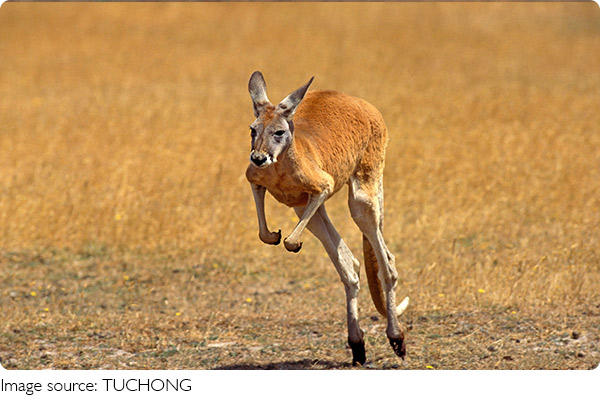
Good day, Readers! When most people picture a kangaroo, they imagine a powerful animal hopping across open land with a fluffy joey peeking out from its pouch. But few realize just how fragile that joey is at the beginning of its life.
A newborn kangaroo is not a miniature version of its mother. In fact, it is born so undeveloped that it looks closer to an embryo than a fully formed mammal. Its survival depends entirely on one extraordinary feature — the pouch.
A Birth Unlike Almost Any Other Mammal
In the animal kingdom, pregnancy lengths vary dramatically. Some mammals spend nearly two years developing before birth. Kangaroos take the opposite approach. Most kangaroo species give birth after only about 30 to 36 days of pregnancy, one of the shortest gestation periods among mammals.
Is it a shadow or a leopard? The answer may surprise you!
How feathers, oils, and grooming allow ducks to stay dry and comfortable in rain and cold water environments
Exploring the adaptations, behavior, diet, and conservation of red pandas
Vanishing Shadows: The Mysterious Mountain Predator With Only 4000 Units Left!
A science-based guide to maintaining a healthy and stable aquarium environment for goldfish
Why red pandas are a distinct species and how they differ from giant pandas
This extremely brief pregnancy is possible because kangaroos belong to a group called marsupials. Unlike placental mammals, which nourish their young internally for long periods, marsupials give birth very early and complete most development inside the pouch.
At birth, a kangaroo joey weighs less than a gram and is usually only around two centimeters long. Its body is pink, almost transparent, and completely hairless. The eyes remain sealed shut, the ears are unfinished, and the back legs are barely formed. Several organs, including parts of the lungs and digestive system, are still immature.
However, one part of the body develops surprisingly well before birth — the front limbs. These tiny arms are strong enough to pull the newborn upward through its mother’s fur immediately after delivery. Without them, the joey would never survive its first few minutes.
The Dangerous Climb to the Pouch
One of the most remarkable moments in a kangaroo’s life happens only seconds after birth. The mother does not carry the joey into the pouch herself. Instead, the newborn must complete the journey alone.
After emerging from the birth canal, the joey begins crawling upward across the mother’s abdomen. Since it is blind, it relies heavily on smell and touch. Researchers have observed that female kangaroos sometimes lick a path through their fur, creating a moist scent trail that guides the tiny newborn toward the pouch opening.
Although the distance may only be a few inches, the climb is exhausting for such a weak creature. The joey pauses frequently, gripping tightly onto fur while inching forward with its front limbs. If it falls, it cannot climb back up again. Once inside the pouch, the newborn immediately searches for a source of milk from the mother.
This stage is critical. The milk source swells inside the joey’s mouth, creating a secure attachment that keeps it connected for months. At this age, the joey is far too underdeveloped to drink milk on its own. Instead, the mother’s muscles gently pump milk directly into its mouth. For the next several months, the joey rarely releases its grip from the mother’s pouch attachment.
The Pouch Functions Like an External Nursery
The kangaroo pouch is far more than a simple carrying pocket. Biologists often describe it as a second stage of pregnancy happening outside the body. Inside the pouch, the environment stays warm, humid, and protected. This is essential because newborn joeys cannot regulate their own body temperature. Without the pouch’s insulation, exposure to cold or dryness would quickly become fatal.
The pouch also shields the joey from predators, parasites, and harsh weather while its body continues developing. During this period, major physical changes happen rapidly. The lungs mature, the hind legs lengthen, muscles strengthen, and fur gradually begins covering the skin.
At around four months old, the joey finally starts looking more recognizable as a kangaroo. Fine fur spreads across its body, and its facel features become more defined. By approximately five months, its eyes begin to open for the first time. Even then, life outside the pouch is still impossible for long periods. Young joeys remain tucked safely inside while continuing to grow stronger.
A Mother’s Milk Changes as the Joey Grows
One of the most advanced aspects of kangaroo biology is the mother’s milk production. Scientists have found that kangaroo milk changes composition throughout the joey’s development. In the earliest stage, the milk contains nutrients specially designed for an animal that is still developing organs and tissues. Later, the milk becomes richer in fats and proteins as the joey grows larger and more active.
Even more astonishing, a female kangaroo can produce two different types of milk at the same time. This happens when she is caring for an older joey outside the pouch while also nursing a younger newborn inside it. Each milk source can provide nutrients specially matched to the needs of a different offspring.
This ability allows kangaroos to reproduce efficiently even in unpredictable environments where food availability changes with rainfall and seasonal conditions.
Leaving the Pouch Is Only the Beginning
Around six to seven months of age, many joeys begin cautiously poking their heads out of the pouch. Soon afterward, they start taking short trips outside. These first explorations are brief and nervous. At the slightest sign of danger, the joey quickly dives back into the pouch headfirst.
As the joey grows heavier, the mother continues carrying it despite the increasing strain. In larger kangaroo species, the pouch occupant may become so big that its legs and tail visibly stick out while traveling. Most joeys continue nursing until they are roughly 14 to 18 months old, depending on the species and environmental conditions.
Even after permanently leaving the pouch, young kangaroos often stay close to their mothers while learning survival behaviors such as grazing, recognizing threats, and navigating social groups.
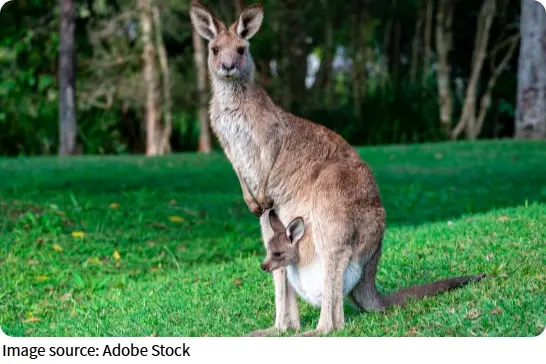
Readers, the life of a kangaroo begins with one of the most difficult starts in the animal world. A creature no larger than a jellybean must crawl blindly toward safety moments after birth, relying entirely on instinct and a remarkable pouch designed by evolution over millions of years.