Soaring High

Liam Reilly
06-08-2024
 · Animal Team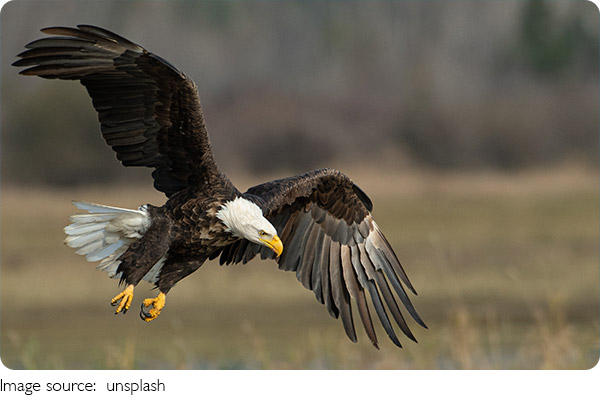
The bald eagle is a renowned bird of prey indigenous to North America.
Revered for its striking appearance and symbolic significance, the bald eagle holds a prominent place in the cultural and natural heritage of the continent.
Physical Characteristics
The bald eagle is easily recognizable due to its distinctive white head and tail feathers, contrasting sharply with its dark brown body and wings. Despite the term "bald," the bird is not bald; the name derives from an older meaning of the word, meaning "white-headed."
Adult bald eagles have a yellow beak and eyes, while juvenile eagles are uniformly brown with mottled white patches, gaining their iconic plumage after about five years.
The Eurasian lynx, with its unique appearance and vital ecological role, symbolizes forest majesty.
Sea turtles' and tortoises' differences in ecology, physiology, and behavior.
Understanding and addressing cats' behavior is essential for ensuring their health and happiness.
Desert bighorn sheep, with their striking spiral horns, thrive in North America's harsh deserts.
8 Stunning Facts About Snow Leopards That Will Leave You Awestruck!
Discover why giraffes have long necks! Reaching high leaves to winning battles and spotting predators, uncover the real reasons now!
Mature bald eagles are large birds, with females typically larger than males. They have a wingspan ranging from 6 to 7.5 feet (1.8 to 2.3 meters) and weigh between 6.6 to 13.9 pounds (3 to 6.3 kilograms).
Their powerful build and strong talons make them formidable hunters, well-adapted to their role as apex predators.
Habitat and Distribution
Bald eagles are primarily found near large bodies of open water, including lakes, rivers, and coastal regions, where they can easily access their primary food source: fish. They are highly adaptable and can be found in diverse habitats ranging from the northern tundra to subtropical regions.
In the United States, the bald eagle's range extends from Alaska and Canada down to northern Mexico. The highest concentrations of bald eagles are found in Alaska, which hosts about half of the world's population, and along the Pacific Northwest coast. These areas provide the ample food supply and nesting sites necessary for the species' survival.

Behavior and Diet
Bald eagles are diurnal birds of prey, meaning they are active during the day. Their diet primarily consists of fish, which they catch using their sharp talons and strong beaks. They are also opportunistic feeders and will consume carrion, smaller birds, and mammals, and even steal food from other birds.
These birds of prey are recognized for their remarkable hunting abilities. They often soar high above the water, using their keen eyesight to spot potential prey from great distances.
Once a target is identified, they dive at speeds of up to 100 miles per hour (160 kilometers per hour) to snatch it from the water's surface. Despite their prowess, bald eagles often scavenge and are known to pirate food from ospreys and other birds.
Bald eagles are monogamous, typically mating for life. They build large nests, called eyries, in tall trees or on cliffs. These nests are among the largest of any bird species, with some measuring up to 13 feet (4 meters) deep and 8 feet (2.5 meters) wide.
Both parents participate in nest building and take turns incubating the eggs, which usually number one to three per clutch. The young eaglets are cared for by both parents and fledge the nest after about 10 to 12 weeks.
Cultural Significance
The bald eagle holds a special place in North America's cultural and historical fabric. It was officially adopted as the national bird and symbol of the United States in 1782, due to its long lifespan, majestic appearance, and association with freedom and strength. The bird is prominently featured on the Great Seal of the United States and various federal emblems, currency, and documents.
Native American cultures have long revered the bald eagle as a sacred creature, representing spiritual protection, wisdom, and power. Eagle feathers are highly prized and used in ceremonies, regalia, and as symbols of honor and respect.
The bald eagle stands as a symbol of resilience and national pride in North America. Its striking appearance, impressive hunting abilities, and cultural significance make it a fascinating subject of study and admiration.
In Conclusion
While its conservation story is a success, continued efforts are necessary to safeguard the habitats and conditions that allow this majestic raptor to thrive.
The bald eagle's journey from the brink of extinction to recovery is a powerful reminder of the impact of human activities on wildlife and the importance of dedicated conservation efforts.