Mesmerizing Feline Gaze

Sofia Alvarez
31-07-2024
 · Animal Team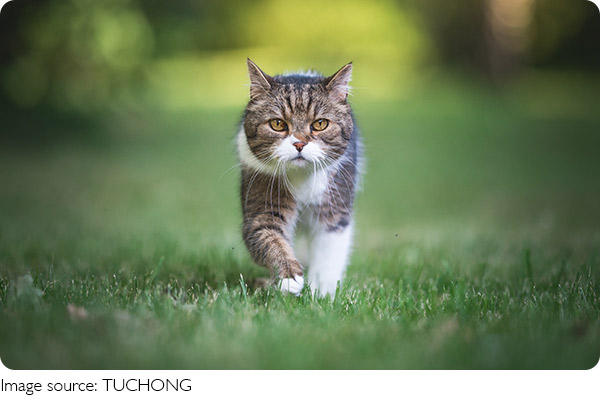
The structure of a cat's eye closely resembles that of a human eye, comprising components like the cornea, iris, lens, and retina.
The intricate interplay of these structures determines the color of a cat's eye, ranging from blue, green, yellow to brown, with subtle transitions between shades primarily determined by the iris.
Unlike human irises that exhibit minimal change with varying light conditions, a cat's iris can contract to a thin slit in bright light. Comprising two layers - the outer stroma and the underlying epithelial tissue - the iris contains pigment-producing cells that dictate its color. The quantity and activity of these cells determine whether the eye appears blue, green, or yellow/brown.
Goats' horizontal pupils provide panoramic vision and balance, crucial for their survival.
The age-old debate over lion vs. tiger strength remains unresolved, now let's discuss their IQs.
Dolphins leap out of the water for communication, hunting, play, and health maintenance.
Can a bird continue to fly when it's asleep? What is the sensory world of birds like?
Dragonflies fly low before rain due to air density changes, showcasing their ancient adaptability.
The Greta oto butterfly's transparent wings blend invisibly, inspiring potential tech innovations.
Besides pigmentation, refraction also influences a cat's eye color, akin to how glass appears transparent from the front but blue or green from the side. This phenomenon alters the perceived color of a cat's eye, adding another dimension to its appearance.
While humans encounter "red-eye" in flash photography due to light reflecting off the retina's capillaries, cats possess a reflective structure called the photographic membrane. Situated in the choroid's middle layer, this membrane enhances night vision by reflecting incoming light back to the retina, augmenting sensitivity in low-light conditions.
The captivating allure of a cat's eyes, with their luminous, slightly slanted gaze, exudes an aura of mystique and fascination. These features, complemented by cats' distinctive facial expressions and physiognomy, make their eyes a hallmark of their enigmatic charm.
Specifically adapted for hunting, a cat's eye boasts lightning-quick reflexes and an expansive field of vision, even in low light. Three layers of eyelids, including a thin protective membrane, ensure constant moisture without the need for frequent blinking, facilitating uninterrupted focus during hunting pursuits.
In essence, the mesmerizing allure of a cat's eye transcends mere aesthetics, embodying a sophisticated adaptation honed through evolution. From its coloration to its reflective properties and functional design, the cat's eye stands as a testament to nature's ingenuity in crafting creatures perfectly suited to their environments.
Cats' eyes are not just visually striking; they are also marvels of evolutionary adaptation. Their slit-shaped pupils can dilate and contract rapidly, adjusting to changes in light intensity and facilitating precise depth perception. This unique feature aids in hunting, allowing cats to accurately gauge distances and pounce on prey with unparalleled accuracy.
Furthermore, cats possess a remarkable ability known as "tapetum lucidum," a reflective layer behind the retina that enhances their night vision.
This layer acts like a mirror, bouncing light back through the retina, effectively giving the photoreceptor cells a second chance to detect photons. As a result, cats can see in light levels six times lower than what humans require, making them highly efficient nocturnal hunters.
In addition to their visual prowess, cats' eyes play a crucial role in communication and expression. Their wide range of pupil dilation and subtle eye movements convey a wealth of emotions, from curiosity and contentment to fear and aggression.
The captivating allure of a cat's gaze has inspired artists, poets, and storytellers for centuries, symbolizing mystery, intuition, and independence.
The intricate anatomy and sensory capabilities of a cat's eye are a testament to nature's ingenuity, honed through millions of years of evolution. Whether as formidable hunters, beloved companions, or sources of artistic inspiration, cats and their mesmerizing eyes continue to captivate and enchant us.