Smithsonian Institution

Naveen Kumar
21-05-2026
 · Travel Team
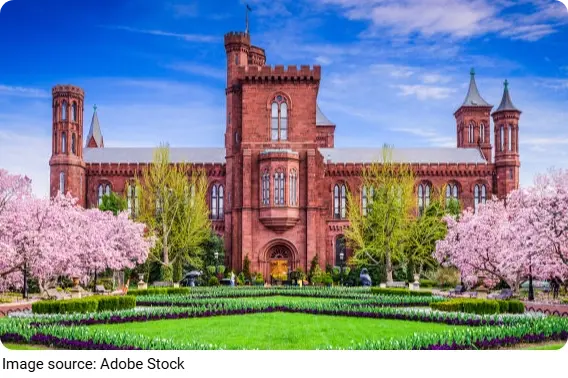
Standing in front of the Smithsonian Institution Building — the red sandstone Castle on the National Mall — it's easy to underestimate what's waiting around you. This isn't a museum.
It's the world's largest museum complex.
Nineteen museums and galleries, a zoo, nine research centers, and more than 140 million objects, works of art, and specimens spread across Washington D.C. and two locations in New York City. Roughly 30 million people visit the Smithsonian Institution each year. And here's the part that stops most people: admission is completely free at every single DC location.
Getting There
The Smithsonian Institution museums are primarily clustered along the National Mall in Washington D.C., stretching from the U.S. Capitol to the Lincoln Memorial along Constitution and Independence Avenues. The Washington Metro is the most practical way to get here.
Harry Potter, Super Nintendo World, a Studio Tour, and a brand-new coaster — one day here is genuinely not enough
From lantern-lit streets to misty peaks, Vietnam unfolds in color, flavor, and calm—crafted for wanderers of every pace and budget.
Diomedes Garden spreads 186 hectares—free entry, themed beds, shaded walks, and quiet escapes minutes from the metro.
Could a flying ram really shape the spirit of Aries?
Why does Virgo feel connected to peaceful harvest energy?
Can the Scales teach you how to choose more wisely?
The Smithsonian Metro Station (Blue, Orange, and Silver Lines) puts you right on the Mall between the National Museum of American History and the National Museum of Natural History — the most direct stop for most visitors. The L'Enfant Plaza station (multiple lines) is another convenient option for the southern Mall museums.
Driving is possible but parking is limited, metered, and can run $15–$30+ for the day. The Metro is simply easier. From Union Station, the Capitol South and Judiciary Square stations are also walkable to Mall locations.
Admission & Hours
Admission to all Smithsonian Institution museums and galleries in Washington D.C. is free — no tickets required for general entry. The only exception is Cooper Hewitt Smithsonian Design Museum in New York City, which charges admission. Most DC museums are open every day of the year except December 25, generally from 10am to 5:30pm.
The National Portrait Gallery and American Art Museum stay open until 7pm daily. Summer extended hours apply to select museums on certain evenings — check the Smithsonian's calendar before planning an evening visit.
A few museums require free timed-entry passes due to high demand. The National Museum of African American History and Culture is the most notable — timed passes are strongly recommended and regularly fill up weeks in advance. The National Air and Space Museum also uses timed entry during peak season, with passes released for rolling six-week windows.
Smithsonian National Museum of Natural History
Where to Start: The Smithsonian Castle
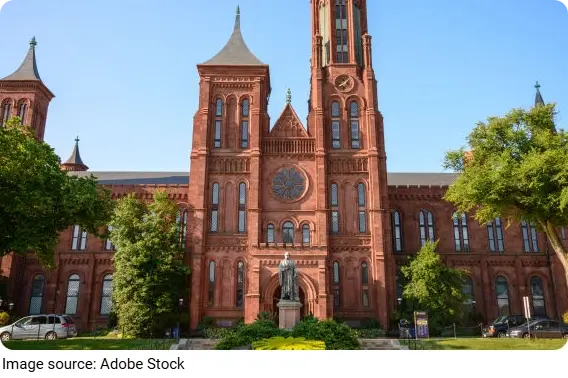
The red-brick Smithsonian Institution Building at 1000 Jefferson Drive SW is the best starting point for any visit. Known simply as the Castle, it houses the main Visitor Center where staff can help you build a focused itinerary based on your interests. The crypt of James Smithson — the British scientist whose estate funded the entire institution — sits just outside the north entrance. Worth a moment of acknowledgment.
Download the free Smithsonian Mobile app before you arrive. It gives you maps, audio tours, exhibit highlights, and a search tool to explore all 19 locations. A paper guide is also available in over 10 languages at any information desk, including Braille versions.
Which Museums to Prioritize
The National Museum of Natural History, National Air and Space Museum, and National Museum of American History are the "big three" — each among the most visited museums in the world. The National Air and Space Museum holds the Wright Brothers' original Flyer and John Glenn's Friendship 7 capsule.
The Natural History Museum is home to the Hope Diamond and the "Deep Time" dinosaur hall. At American History, Dorothy's ruby slippers from The Wizard of Oz and the original Star-Spangled Banner are both on permanent display.
The National Museum of African American History and Culture is newer and deeply powerful — plan at least three hours. The Hirshhorn Museum and Sculpture Garden is a modern and contemporary art standout. Less visited but exceptional: the Freer and Sackler Galleries for Asian art, and the National Museum of African Art.
Practical Tips
Weekday mornings are dramatically less crowded than weekend visits. Arrive right at 10am opening, and head to the exhibit farthest from the entrance first — most visitors naturally cluster near the main entrance, so going up or to the back early gives you a more relaxed experience.
Most museums have two entrances — one facing the Mall and one facing the avenues behind. The avenue-facing entrances often have shorter security lines. Pack light; bag checks are required at several museums including Air and Space.
Where to Stay
Hotels near the National Mall cluster around the Capitol Hill, Penn Quarter, and Downtown DC neighborhoods. Expect to pay $150–$300+ per night at mid-range options. The Mandarin Oriental and L'Enfant Plaza Hotel are closest to the Mall itself. Budget-conscious visitors can find better rates in nearby Arlington, Virginia, which has direct Metro access into DC in under 20 minutes.
The Smithsonian Institution is one of the few great museum complexes in the world where you can explore as much or as little as you want without worrying about ticket prices. Plan your visit around the "big three" — Natural History, Air and Space, and American History — but leave time for smaller gems like the Hirshhorn or Freer galleries.
Arrive early on a weekday, grab a map at the Castle, and remember that free timed-entry passes for the African American History Museum or Air and Space need to be booked weeks in advance. With nineteen museums to choose from, no two visits ever have to look the same.